12 search results for "The Moonstone Part One"

World’s Great Novels: The Moonstone, Part Four (EP4740)

Today’s Mystery: An experiment reveals how the diamond got out of Rachel Verinder’s cabinet. But where is it now?

Original Air Date: April 23, 1948

Originating from Chicago

Starring: Sherman Marks as Gabriel Betterridge; Arthur Sedgewick as Sergeant Cuff; Charles Mountain as Franklin Blake, Jonathan Hull, Dick York, Donald Gallagher, Boris Aplon, Marvin Peisner

Support the show monthly at patreon.greatdetectives.net

Patreon Supporter of the Day: Jennifer, Patreon supporter since April 2025

Support the show on a one-time basis at http://support.greatdetectives.net

Mail a donation to: Adam Graham, PO Box 15913, Boise, Idaho 83715

Take the listener survey at http://survey.greatdetectives.net

Give us a call at 208-991-4783

Follow us on Instagram at http://instagram.com/greatdetectives

Follow us on Twitter @radiodetectives

Join us again tomorrow for another detective drama from the Golden Age of Radio.

World’s Great Novels: The Moonstone, Part Three (EP4734)

Today’s Mystery: After a tragic suicide, Sergeant Cuff’s dismissed with the theft of the Moonstone still unsolved. A year later, someone else picks up the investigation.

Original Radio Broadcast Date: April 16, 1948

Originating from Chicago

Starring: Sherman Marks as Gabriel Betterridge; Arthur Sedgewick as Sergeant Cuff; Charles Mountain as Franklin Blake; Geraldine Kaye as Rachel Verinder; Alma Fox; Jane Elliot; Ruth Shane; Minion Shriver; Sidney Breese; Arthur Peterson, Maurice Copeland

Support the show monthly at patreon.greatdetectives.net

Patreon Supporter of the Day: Jennifer, Patreon supporter since April 2025

Support the show on a one-time basis at http://support.greatdetectives.net

Mail a donation to: Adam Graham, PO Box 15913, Boise, Idaho 83715

Take the listener survey at http://survey.greatdetectives.net

Give us a call at 208-991-4783

Follow us on Instagram at http://instagram.com/greatdetectives

Follow us on Twitter @radiodetectives

Join us again tomorrow for another detective drama from the Golden Age of Radio.

World’s Great Novels: The Moonstone, Part Two (EP4728)

Today’s Mystery:

England’s greatest detective is called in to recover the Moonstone.

Original Radio Broadcast Date: April 9, 1948

Originating from Chicago

Starring: Sherman Marks as Gabriel Betterridge; Arthur Sedgewick as Sergeant Cuff; Charles Mountain as Franklin Blake; Geraldine Kaye as Rachel Verinder; Alma Fox; Jane Elliot; Ruth Shane; Minion Shriver; Sidney Breese; Les Spears

Support the show monthly at patreon.greatdetectives.net

Patreon Supporter of the Day: Rick, Patreon supporter since March 2020

Support the show on a one-time basis at http://support.greatdetectives.net

Mail a donation to: Adam Graham, PO Box 15913, Boise, Idaho 83715

Take the listener survey at http://survey.greatdetectives.net

Give us a call at 208-991-4783

Follow us on Instagram at http://instagram.com/greatdetectives

Follow us on Twitter @radiodetectives

Join us again tomorrow for another detective drama from the Golden Age of Radio.

The World’s Great Novels: The Moonstone, Part One (EP4722)

Today’s Mystery:

In the mid-19th Century, a young English woman has inherited a large Indian diamond from her evil uncle. She decides to wear it as a brooch on her eighteenth birthday. What could go wrong?

Original Radio Broadcast Date: April 2, 1948

Originating from Chicago

Starring: Sherman Marks as Gabriel Betterridge; Charles Mountain as Franklin Blake; Geraldine Kaye as Rachel Verinder; Alma Fox; Jane Elliot; Ruth Shane; Sidney Breese; Arthur Peterson; Boris Aplon; Margaret Brayton

Support the show monthly at patreon.greatdetectives.net

Patreon Supporter of the Day: Harold, Patreon supporter since September 2017

Support the show on a one-time basis at http://support.greatdetectives.net

Mail a donation to: Adam Graham, PO Box 15913, Boise, Idaho 83715

Take the listener survey at http://survey.greatdetectives.net

Give us a call at 208-991-4783

Follow us on Instagram at http://instagram.com/greatdetectives

Follow us on Twitter @radiodetectives

Join us again tomorrow for another detective drama from the Golden Age of Radio.

EP3334: Suspense: The Moonstone, Part Two (Encore)

Peter Lawford

The search for the Moonstone is on. Mister Blake is helping lead the search and receiving an angry reaction from Rachel, who leaves the house refusing to speak to him.

Original Air Date: November 23, 1953

Become one of our monthly patreon supporters at patreon.greatdetectives.net

Support the show on a one-time basis at http://support.greatdetectives.net.

Mail a donation to: Adam Graham, PO Box 15913, Boise, Idaho 83715

Take the listener survey…http://survey.greatdetectives.net

Give us a call 208-991-4783

Become one of our friends on Facebook.

Follow us on Twitter @radiodetectives

EP3333: Suspense: The Moonstone, Part One (Encore)

Peter Lawford

A young man delivers an Indian diamond to his cousin on her birthday, a diamond that brings woe to the entire house.

Original Air Date: November 16, 1953

Become one of our monthly patreon supporters at patreon.greatdetectives.net

Support the show on a one-time basis at http://support.greatdetectives.net.

Mail a donation to: Adam Graham, PO Box 15913, Boise, Idaho 83715

Take the listener survey…http://survey.greatdetectives.net

Give us a call 208-991-4783

Become one of our friends on Facebook.

Follow us on Twitter @radiodetectives

EP1818: The Suspense: The Moonstone, Part Two

Peter Lawford
The search for the Moonstone is on. Mister Blake is helping lead the search and receiving an angry reaction from Rachel, who leaves the house refusing to speak to him.

Original Air Date: November 23, 1953

Support the listener support campaign:

Support the show monthly at patreon.greatdetectives.net

Support the show on a one-time basis at http://support.greatdetectives.net.

Mail a donation to: Adam Graham, PO Box 15913, Boise, Idaho 83715

(more…)

Suspsense: The Moonstone, Part One (EP1812)

Peter Lawford

A young man delivers an Indian diamond to his cousin on her birthday, a diamond that brings woe to the entire house.

Original Air Date: November 16, 1953

Support the listener support campaign:

Support the show monthly at patreon.greatdetectives.net

Support the show on a one-time basis at http://support.greatdetectives.net.

Mail a donation to: Adam Graham, PO Box 15913, Boise, Idaho 83715
(more…)

Book Review: The Moonstone

Published more than a decade before A Study in Scarlet, The Moonstone was the first detective novel, although two decades after Edgar Allen Poe’s Dupin stories. In it, a young woman receives a fabulous Indian diamond (believed to be cursed and hunted by fanatical Hindu priests travelling incognito.) at her birthday party at her family’s country house. The diamond is stolen and the reactions of its owner and many other people are quite bizarre and mysterious.

There’s a lot to commend the story. The character of Gabriel Betteredge, the family is delightful, a character who is fiercely loyal to the family serves, old fashioned, is quirky, and opinionated, while also being very kind and decent. The two fifths of the book where he serves as narrator had me fully engaged with his love of Robinson Crusoe and his homespun philosophy. Sergeant Cuff, the independent detective called in to consult the case, really is a well-drawn early picture of that sort of consulting detective who’d taken the world by storm by the end of the 19th.

The mystery itself was interesting and had some fairly good twists.  It’d be easy for many modern readers to view the novel as cliched, but it was all original back in 1868. The book is worth reading for its historic value as it provides key insights into the development of one the most popular forms of fiction ever devised.

In terms of how the book held up after nearly 150 years, I have mixed feelings. Collins was a good writer and most of the chapters were quite interesting, but he lacks that timeless quality of the best writers in that great era of British literature. The Moonstone uses multiple first-person narrators, each offering their own account of various events in the story. Some are there for scores of pages, some only one or two.  The problem I had is  I didn’t find many of these narrators compelling, and many I didn’t care about at all.

The Miss Clack chapters were the most tedious reading I had in a long time as Mr. Collins seemed to have gone off on a very long tangent about religious hypocrisy that seemed really unrelated to the story. The book really does seem to lose focus in the middle, and there’s way too much melodrama. The book could have easily been 100 pages shorter and been better for it.

Still, there’s no denying that the book was a groundbreaking work and that every fan of  detective fiction owes a debt to Collins. As a mystery itself, there’s so much to commend the story even if it’s hurt by a few (by modern standards) questionable narrative decisions. Still, I found it more interesting as a historical artifact than as leisure reading.
Rating: 3.5 out of 5.0

If you enjoyed this post, you can have new posts about Detective stories and the golden age of radio and television delivered automatically to your Kindle.
The Casebook of Gregory Hood

Listen to “The Gentlemen Detectives of Old Time Radio” on Spreaker.

The Casebook of Gregory Hood began as a summer replacement for Sherlock Holmes over Mutual written by Sherlock Holmes writers Denis Green and Anthony Boucher.  When Sherlock Holmes didn’t return, the series continued to air through the whole 1946-47 season and would return in 1948 with Elliot Lewis in the lead before moving to ABC and continuing to air episodes into the 1950s.

The series followed the adventures of Gregory Hood, a suave bachelor San Francisco importer who also found himself often constantly involved homicides. He’s aided in his adventure by aide the more down to earth company attorney Sanderson Talor.

Star Biographies:

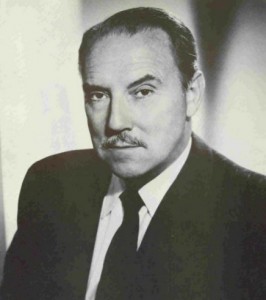
Gale GordonGale Gordon (1906-95):  For fans of classic television, Gale Gordon earned a reputation for playing crochety authority figures. He was the second Mr. Wilson on the classic Dennis the Menace series and in his association with Lucille Ball in programs like Theodore Mooney in The Lucy Show and Harrison Carter in Here’s Lucy.

Some of this began over radio with his role of Osgood Conklin in Our Miss Brooks as Rudolph Atterberry. However as memorable as these roles were (particularly Conklin), Gordon’s repertoire was more multi-faceted than that. He was the first actor to play Flash Gordon over the radio. He played Mayor La Trivia on Fibber McGee and Molly. He also was chosen to play the suave amateur detective Gregory Hood in 1946 for Petri Wine and Mutual. There were countless other appearances in a wide variety of character roles that established Gordon as equally talented as a dramatic and comedic actor on programs ranging from Tarzan to Burns and Allen, and Suspense.

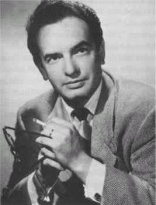
Elliot LewisElliot Lewis (1917-90)  was often known as Mr. Radio. His career over the air was multi-faceted and has left an indelible mark. He was a talented dramatic actor. He played Captain Philip Kearney in the well-remembered Voyages of the Scarlet Queen. He also took his turn as a radio detective in both The Casebook of Gregory Hood and played Archie Goodwin in Mutual’s Amazing Nero Wolfe, and then starred with his then-wife Cathy Lewis in On Stage which pushed him into a wide variety of genres.

He was also a great comic actor, providing fantastic character work on Burns and Allen, in addition to enjoying a memorable recurring role on the Phil Harris and Alice Faye show.

Yet, with all that said, Lewis did not particularly enjoy acting. He wanted to produce and direct radio. In the 1950s, this happened as he served as producer/director of Broadway is My Beat, a program that captured the full flavor of New York’s diverse population and where characters often spoke in memorable  and brooding poetry. He took the helm at Suspense and pushed the show in different directions including adapting Othello and the Moonstone in multi-part episode, doing a two part episode that proposed an ending to Charles Dickens’ unfinished novel The Mystery of Edwin Drood, and giving guest spots to comedy actors like Bob Hope and Jack Benny who rarely got dramatic roles.

While he worked in television, his dedication to radio and his reputation for excellence continued. When Rod Serling experimented with radio drama in 1973 with his Zero Hour  series, Lewis once again found himself as producer/director.  And he also got the call for 1979’s Sears Radio Theater. 

Jackson BeckJackson Beck (1912-2004): Jackson Beck had many roles in radio. He starred for Ziv as that once-popular private detective Philo Vance. However, where he really distinguished himself was on Superman. He’s best known as the announcer of that program who delivered the show’s memorably opening. However, Beck showed flexibility by not only announcing, but also acting in the show. As the Jimmy Olsen character grew up on the radio, he took on the role of Beany Martin, a copyboy. He also had the distinction of being the first actor to portray Batman’s butler, Alfred Pennyworth.  His contributions to radio drama continued long after Superman left the air in 1951. He was probably the biggest to appear on the radio in the September 30, 1962 golden age of radio finale as he appeared in “The Tip Off Matter” on Yours Truly Johnny Dollar. He continued to make radio appearances frequently with numerous appearance on radio revival shows such as Theater Five, the General Mills Adventure Theater, and The CBS Mystery Theater. 

Episode log:

Gale Gordon Episodes:

Elliot Lewis Episodes:

Jackson Beck Episodes:

Log source: Digital Deli

*Played out of order

End of Log


Radio’s Most Essential People Countdown #9

Previous Posts: 1012-1114-1316-1518-1720-19,22-2124-2326-2528-2730-2933-3136-3439-37,

42-4045-4348-4651-4954-5257-5560-5865-6170-66,  71-7576-8081-8586-9091-9596-100

9) Elliott Lewis

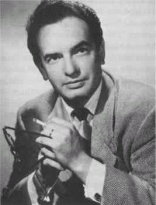
Elliott LewisLewis was often known as Mr. Radio. His career over the air was multi-faceted and has left an indelible mark. He was a talented dramatic actor. He played Captain Philip Kearney in the well-remembered Voyages of the Scarlet Queen. He also took his turn as a radio detective in both The Casebook of Gregory Hood and played Archie Goodwin in Mutual’s Amazing Nero Wolfe, and then starred with his then-wife Cathy Lewis in On Stage which pushed him into a wide variety of genres.

He was also a great comic actor, providing fantastic character work on Burns and Allen, in addition to enjoying a memorable recurring role on the Phil Harris and Alice Faye show.

Yet, with all that said, Lewis did not particularly enjoy acting. He wanted to produce and direct radio. In the 1950s, this happened as he served as producer/director of Broadway is My Beat, a program that captured the full flavor of New York’s diverse population and where characters often spoke in memorable  and brooding poetry. He took the helm at Suspense and pushed the show in different directions including adapting Othello and the Moonstone in multi-part episode, doing a two part episode that proposed an ending to Charles Dickens’ unfinished novel The Mystery of Edwin Drood, and giving guest spots to comedy actors like Bob Hope and Jack Benny who rarely got dramatic roles.

While he worked in television, his dedication to radio and his reputation for excellence continued. When Rod Serling experimented with radio drama in 1973 with his Zero Hour  series, Lewis once again found himself as producer/director.  And he also got the call for 1979’s Sears Radio Theater. 

Elliot Lewis, a talented actor, and great producer of radio dramas well deserves his ranking as one of radio’s ten most essential people.

If you enjoyed this post, you can have new posts about Detective stories and the golden age of radio and television delivered automatically to your Kindle.
To be Continued…

To be Continued is a word fraught with mixed emotions for many television viewers. When their favorite Television show embarks on a muliple episode story line, viewers are guaranteed more complex, more involved, and perhaps developed stories. On the downside, there’s the long wait to find out what happened next week or in some cases, next season.

Many radio detectives began as 15 minute serialized programs in the 1930s and 1940s. Programs such as I Love a Mystery, Charlie Chan, A Man Called Jordan, and Mr. Keen, Tracer of Lost Persons began as 15 minute serials. However, most went to half hour format. And in the half hour format, each episode was a self-contained story with very few exceptions.

What were these rare multi-part episodes of half hour programs?

Generally, adapting a novel as a half hour radio series guaranteed the novel would be condensed beyond recognition, so a few mystery novels were adapted to radio in multiple parts. In the 1930s, several Charlie Chan novels were adapted this way. In addition, the  Adventures of Sherlock Holmes radio franchise adapted three of the Holmes’ Novels in the midst of doing half hour adaptations of Doyle’s stories as well as original stories based on suggestions in the stories. Only one of these (from the Rathbone-Bruce perfomance) is in circulation.

Another detective story to get the multi-part adaption was Wilkie Collins’  The Moonstone considered by many to be the first detective novel, it was adapted in four parts by NBC’s series The World’s Great Novels and then in two parts for Suspense, both of which are in circulation.

Beyond these literary adaptations, there were some detectives that ventured into the land of To Be Continued…

Adventures of Sam Spade (1946):In November 1946, CBS tried what had to be one of the boldest ratings plays ever in making a radio sequel to The Maltese Falcon called the Khandi Tooth Caper. The original movie was an all-time classic, so this radio version was against tough odds. Still, CBS must have gotten good reaction, because when Suspense expanded to an hour, CBS smashed the two scripts of Sam Spade together to make one hour long episode of Suspense.  Thus, while the original Sam Spade episodes aren’t in circulation, the one hour Suspense story is about the same thing only with a cameo by Philip Marlowe.

Sherlock Holmes (1949) : In John Stanley’s second season of Holmes, Mutual experimented with doing multi-part stories in “The Elusive Agent” trilogy which as the title implies was much more of a spy story than a traditional detective mystery. It appears that they didn’t quite get the reaction from the public that they heoped for to the experiment as they’d hoped for, as it wasn’t repeated.

Candy Matson (1950): According to Digital Deli, Candy Matson’s attempt at the two part episode was a bit of fiasco. To begin with, without any notice to its audience NBC moved the show leading, a local newspaper to print, “Don’t tune for Candy Matson tonight on KNBC, because she will not be present. In a last minute move, KNBC put the show on last night at 7 o’clock. ”

Then an episode with a cliffhanger with Candy praying the 23rd Psalm as an airplane was crashing into a lake. The show didn’t air the next Monday, but that was because NBC movied it back to Tuesdays. Under such circumstances, getting one parters done was hard enough. Sadly, the episodes are not in circulation.

Dragnet (1950-53): Jack Webb did a grand total of six two part episodes out of Dragnet’s first two hundread and six. These were more elaborate story lines that allowed for a more-in-depty portrayal of criminal investigations. None of the episodes were cliff-hangers. With the exception of “The Big Mask,” the two parters showed Friay and his partner capturing accompliaces, but still in need of getting Mr. Big. The two parters fell out of favor in the final third of Dragnet’s run. This may be because viewers had not reacted well to the only Dragnet two parter to air over television and by mid-to-late 1953, the radio show had become the source for future scripts to the television series, so if it couldn’t be used on television, it wasn’t much good to do it.

Yours Truly Johnny Dollar (1957-59): Johnny Dollar in the Bob Bailey era was best known for its five part serials from 1955-56, after which it shifted to the half hour format. However, the show also turned out one two part episode a year from 1957-59. This included “The Mason-Dixon Mismatch Matther” and “The Dixon Murder Matter” from 1957 and the two part “Mojave Red Matter” (1958)  and “Buffalo Matter” (1959). The multi-part matters became more necessary as CBS became more aggressive in selling ads, thus cutting the amount of time for plot down to a minimum. Two two part episodes may have only had a little more plot than what used to be single 30 minute shows.

Matthew Slade, Private Investigator (1964): Just past the traditional endpoint for Old Time Radio (September 30, 1962), this show was a solid radio revival entry which attempted to recreate the feel of hard boiled detectives. It began with a three part serial, The Day of the Phoenix. While Parts 1 and 2 are available everywhere, Part Three is hard to lay its hands on.

These multi-part episodes are fun when you can find them,  but in a way, I’m glad there weren’t more. With so many gaps in old time radio series, we benefit from having self-contained shows that don’t require two or three shows ahead of it be intact as well. The way radio worked out in the 1940s and 50s has made it possible to enjoy prograsms without having to worry about gaps.

If you enjoyed this post, you can have new posts about Detective stories and the golden age of radio and television delivered automatically to your Kindle.