Captain Philip Kearney is hired to deliver a set of Queen Anne Pistols to a gun dealer when the Scarlet Queen is in port in Australia.
Original Air Date: February 18, 1948
Johnny is called in to deliver a pair of highly insured Queen Anne Pistols to a Gun Dealer in Boston.
Original Air Date: November 4, 1950
Two treasury agents head Europe to bust a criminal who took the life savings of a Holocaust survivor and exchanged it for counterfeit U.S. currency.
Original Air Date: November 11, 1951
Become one of our monthly patreon supporters at patreon.greatdetectives.net
Note: A version of this article was published in 2015.
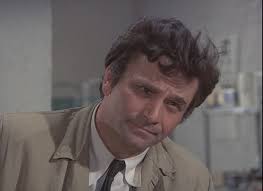
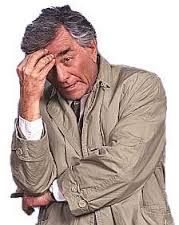
Peter Falks had two runs as Columbo. The first ran from 1971-78 over NBC as part of the network’s Mystery Wheel. Columbo returned in 1989 over ABC in a series of TV movies, with the last airing in 2003.
There were four key differences between the newer Columbo films and the originals:
1) Length
Most of the original Columbo films had a 90 minute time slot on air which made them about 70-75 minutes without commercials. The new Columbo films took up 2 hours and had a running time of approximately 90 minutes. I have to admit, in general, this was a case of “less is more.”
One key example was the second ABC Columbo, “Murder, Smoke, and Shadows” where the film started strong but dragged on too long and at the end of Columbo’s denouement we had (and I kid you not), the police coming out and doing a musical number when they announced the arrest.
The old Columbos worked because of their limitations. They didn’t go on forever, and when there was a longer case thrown in such as with, “A Friend Indeed,” the time was well-spent while the only new film that I think benefited from the longer running time was, “Agenda for Murder.”
2) More Adult Content
Columbo in the 1970s remains a tasteful family-friendly TV show. The latter Columbo had a lot more sex in the plot and a lot more skin on the screen. A few episodes featured lurid plots and disturbing murder scenes. Of course, this isn’t to say that all of the latter Columbos were strictly adult affairs but quite a few pushed the envelope.
With one exception, the added sexual content and violence tended to detract rather than add to Columbo. At its core, the strength of Columbo are great characters and their interactions, and the episodes that had the most adult content such as, “Uneasy Lies the Crown” and “Murder: A Self Portrait” tended to sacrifice quality for titillation. If there was an episode that seemed more “grown up” that did work, it was, “It’s All in the Game” starring Faye Dunaway as a suspect who is trying to seduce Columbo to keep him off her trail but that works because of the character interactions.
3) More Experimentation
Of the forty-four 1970s Columbo films, only one messed with the formula of Columbo being an inverted mystery (Season 5’s “Last Salute to the Commodore.”) Of the twenty-four revived shows, there were half a dozen different attempts to break with the formula. These variations ranged from following the killer up to the point of the murder and finding someone else had already committed the murder, not showing the murder and then planting doubt as to the killer’s guilt, and then there were two adaptations of Ed McBain novels.
“Last Salute to the Commodore” was one of my two least favorite 1970s episodes, but some of these later experiments aren’t too bad. “Rest in Peace, Mrs. Columbo” begins with the funeral of “Mrs. Columbo” and is told through flashback from the point of view of a woman seeking revenge on the good Lieutenant by murdering his wife. The McBain novel adaptation, “Undercover” is a fine thriller if you can get past the fact Columbo’s behavior is inconsistent with everything we know of the character. “Columbo Cries Wolf” also had some good moments,.
The other three are more problematic, but not for messing with the formula. Still, while some of the revived Columbos that go in other directions can be entertaining, they still can’t beat the best of the “normal” Columbo episodes.
4) Less Star Quality
The original Columbo was knownfor the amazing casting. Among the actors who played Columbo murderers in the old days were Anne Baxter, Robert Culp, Leonard Nimoy, Roddy McDowell, Martin Landau, Dick Van Dyke, Patrick McGoohan, Ricardo Montalban, Ruth Gordon, and so many more. Peter Falk was a fantastic actor and had great chemistry with so many guest stars and that chemistry made the 1970s episodes so memorable.
The new series had a virtual power outage, particularly in 1989 and 1990. Of the first eleven villains, the only actor in Falk’s league was McGoohan. The second best of the group was Fisher Stevens. That’s a big gap.
The series did get better guest stars between 1991-94 when Columbo cut back from 4-6 films a year to between 2 and 3 films. The results were among the best of the new run as Faye Dunaway was nominated for both an Emmy and a Golden Glove for her appearance. Dabney Coleman, George Hamilton, and Rip Torn turned in memorable and satisfying performances in their turns against Columbo.
Of course, not even a good guest star could save some films. A mustached William Shatner is miscast in Butterfly in Shades of Grey. Tyne Daley did the best she could with a fairly stereotypical flirty lush role in A Bird in the Hand but deserved far better as a Columbo villainess.
Conclusion
There did seem to be a fair share more stories in the later years that strained credulity in terms of motive or were plain derivative (i.e. “Strange Bedfellows.”)
Yet, the one thing that remained the same was Peter Falk. Some episodes felt like the only thing good in the movie was Columbo but almost always that still made it worth watching. There’s so much in every moment when Falk’s on the screen that he can carry the show by himself which was a good thing because he often had to.
By almost every measure, ABC’s Columbo was an inferior product to its predecessor, but it provided two dozen opportunities to see Peter Falk in action as his greatest character and that makes most of them worth viewing.
You can watch the 1970s episodes of Columbo on IMBD TVand all episodes of the series are available for viewing on Peacock.
The rehearsal for the Lux Radio theater adaptation of the Disney classic including many members from the original cast including Kathryn Beaumont (Alice), Ed Wynn (The Mad Hatter), Jerry Colona (The Marsh Hare), Bill Thompson (The White Rabbit), and Joseph Kearns (The Doorknob)
Rehearsal for Program that Aired: December 24, 1951
An ape trainer in a circus act is killed in his act and Casey suspects murder.
Original Air Date: May 1, 1947
Support the show monthly at patreon.greatdetectives.net
Mike tries to get a picture of a prize fighter from his old neighborhood who has been blowing off the press. Mike gets punched out in a sparring match by the boxer and then asked to help him.
A special agent for the post office journeys to Mexico to uncover the sources of a bomb sent in the mail to Washington, DC.
Original Air Date: November 4, 1951
Become one of our monthly patreon supporters at patreon.greatdetectives.net
Silent are the Dead is an original Flash Casey novel by George Herman Coxe. It 1941, it was originally serialized in Black Mask Magazine (where Casey made his debut in 1934) in three parts, and published as a standalone novel in 1942.
In it, ace photographer Flash Casey has to get pictures of a disgraced lawyer after his camera case is stolen and his film exposed. When he goes up to the lawyer’s apartment, he finds the lawyer dead and himself in a case that grows ever more complex.
Flash Casey is an interesting character. He bares little resemblance to the character who’d arrive on radio the next year and less to the hotheaded goofball of the film Here’s Flash Casey. Casey is a decent sort. He’s got a nose for news but he’s neither heartless, nor unethical. He’s got a hard boiled edge to him, but this never goes over the top. He also takes a great deal of pride not just in his own work, but in the profession and its status, which motivates his actions in the final act of the novel.
This is a solidly written mystery novel. The plot is complex and intriguing with twists around every corner. The story is well-plotted, and well-paced. My interest never lagged from start to finish. I appreciated how photography was used in the novel to make this story distinct from the countless tales of private eyes, lawyers, and mystery men that dominated the fiction shelfs of the day. I’ve experienced a few stories from the old Black Mask magazine and compared to them, this book is above average.
The characterization is not a huge strength. With one exception, the other characters feel mostly functional. They’re not unrealistic, over the top, or badly written, but as individuals, they’re surface level and blend quickly into a sea of newspaper employees, gangsters, damsels/potential femme fatales, and cops without much personality to distinguish them. Still, with Casey being well-written, he’s an anchor that keeps the story interesting.
In terms of quality, I’d consider it similar to the best Michael Shayne books. It’s not a genre classic by any means, but it is a good example of a pre-War detective novel with hard-boiled flavor. In addition, its photographer hero makes it stand out from most of its mystery peers. It’s also a nice read for those who enjoy the Casey, Crime Photographer radio series and are curious about the hero’s literary origins.
Rating: 4.0 out of 5.0
This post contains affiliate links, which means that items purchased from these links may result in a commission being paid to the author of this post at no extra cost to the purchaser.
Johnny goes to Cuba to try and get a man to reveal where he stashed a fortune in jewels before he’s extradited. His job is complicated when a knife-wielding maniac springs the man from jail.
Original Air Date: September 19, 1951