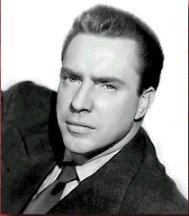
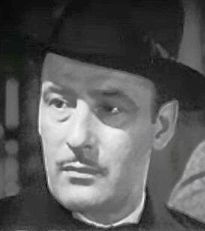
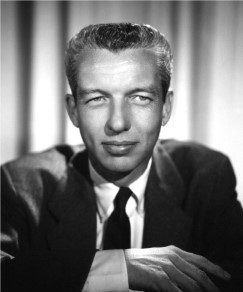
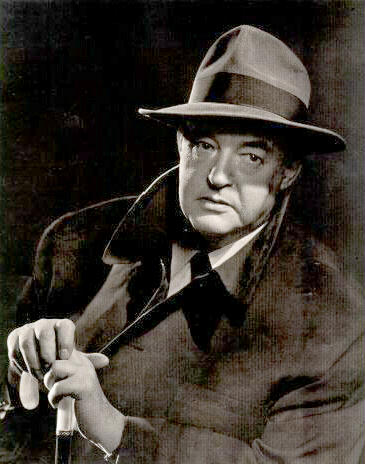
Pat Abbott goes to Las Vegas at the request of the government to find a secret formula.
Original Air Date: February 20, 1955 (AFRTS Rebroadcast.)
Click here to download, click here to add this podcast to your Itunes, click here to subscribe to this podcast on Zune, click here to subscribe to this feed using any other feed reader.
This episode has a good twist in it. For starters, the primary villain is none other than the Deputy Commissioner of Police (played by Richard Kiley). For another, he didn’t commit the initial homicide.
The story begins with a friend of the Deputy Commissioner meets him at a bar and tells him he just killed his wife in a moment of rage and doesn’t know what to do. The Commissioner assures him he’ll take care of it and carefully re-arranges the crime scene to make it look like it was the work of a burgular who had been hitting local homes and arrange an alibi for his neighbor.
Then the Commissioner murders his own wife and uses the occasion of the wake for the first man’s wife to enlist the help of the first killer in covering up his own murder.
This case presents a unique challenge to Columbo. There are several cases when the prominent murderers he hunts will use their connections to pressure Columbo to back off, but this time Columbo is facing off against corrupt superior with more direct authority and control over the investigation. Even as Columbo produces more inconsistencies with “the burgular did it” story, the Commissioner pushes him towards that one answer.
The Commissioner is one of Columbo’s chilling villains, combining his sociopathic nature, an intimidating personality, and the raw power of a high police official.
In the end, Columbo has to get very creative and enlist the help of the real burgular to solve the case in one of Columbo’s memorable endings.
2) Now, You See Him-1976
This episode is the second Jack Cassidy episode on the list. This is perhaps the Columbo episode I enjoyed the most. Cassidy is fantastically believable as the Great Santini, a clever magician with a past that he must keep secret at all costs which leads him to kill his employer who is blackmailing him.
Even though, the music and style of the Great Santini are totally 1970s, there’s a certain edge of coolness even watching this episode 30 years later, and Cassidy plays the murderer with a great deal of charm throughout the episode.
This episode saw the return of Sergeant Wilson (Bob Disky). Wilson had appeared in the 1972 episode, “The Greenhouse Jungle” as a young by the book police sergeant who chafed against Columbo’s unorthodox methods, only for Columbo to be proven right after Wilson arrested the wrong man. In, “Now You See Him,” Wilson has grown a bit and actually is helpful to Columbo on the case. It should be noted that this is the only time that giving Columbo a sidekick worked out well.
With a solid denouement featuring Columbo’s own magic trick with some key help from Sergeant Wilson, this is a fun way to spend 75 minutes.
1) A Stitch in Crime-1973
This episode begins with a fairly clever murder plot in which a Dr. Barry Mayfieldplans to murder his partner by putting temporary sutures where permanent ones ought to go, which will lead to the doctor’s death. A nurse finds out and the Mayfield kills her to stop her from spilling the plan.
As Nimoy is most famous for playing Spock on Star Trek many reviews will reference this as Spock v. Columbo. The comparison is not entirely without merit. Nimoyis cold, calculating, and throughout most of the episode, detached and unemotional. He’s the picture of a perfect sociopath and very menacing. The scene right before he murdered the nurse is perhaps the most startling in the series.
Like with “A Friend in Deed,” what makes Mayfield a particularly dangerous killer is not just that he’s a heartless murderer, but his position. In this case, as he’s a doctor who is supposed to be a healer, it adds another dimension to the character.
In this episode, Columbo has to work to prevent the original murder that Dr. Mayfield set out commit. This adds some additional tension to the episode that isn’t your ordinary episode of Columbo. This episode is also notable for being one of the occassions where Columbo gets mad at a killer and shows it:
The ending to this episode just can’t be beat. As we get to the end, it does look like Columbo may have lost or more accurately, got a split decision that will leave Dr. Mayfield free. It’s only in the last forty-five seconds that Columbo pulls it out.
Of course, other fans have their favorites. And it’s a hallmark of Columbo movie reviews that on nearly every 1970s episode, some fans will insist it was one of Columbo’s best and others will insist it was one of the weakest. Your feedback is always welcomed.
The entire 1970s Columbo Series is available on DVD from Amazon, along the 1989 and 1990 Mystery Movies series. The 1991-93 Mystery Moviesseries will be available on DVD February 8th. Episodes of Columbo are also available on DVD and Instant Watch from Netflix.
This post contains affiliate links, which means that items purchased from these links may result in a commission being paid to the author of this post.
UPDATE:
Linked by the Rap Sheet where folks are discussing their own favorites and suggesting substitutions.
Click here to download, click here to add this podcast to your Itunes, click here to subscribe to this podcast on Zune, click here to subscribe to this feed using any other feed reader
Click here to download, click here to add this podcast to your Itunes, click here to subscribe to this podcast on Zune, click here to subscribe to this feed using any other feed reader
George tries to help a man who was just released from prison understand the cause of his wife’s death. Then the man who accidentally hit his wife is shot and the man disappears.
Click hereto download, click here to add this podcast to your Itunes, click here to subscribe to this podcast on Zune, click here to subscribe to this feed using any other feed reader.
Click hereto download, click here to add this podcast to your Itunes, click here to subscribe to this podcast on Zune, click here to subscribe to this feed using any other feed reader.
Click here to download, click here to add this podcast to your Itunes, click here to subscribe to this podcast on Zune, click here to subscribe to this feed using any other feed reader
7) Fade Into Murder (1976): This episode of Columbo was far from the most difficult case Columbo had to crack, however the guest murderer made the episode entertaining.
William Shatner plays the role of Actor Ward Fowler. Fowler plays a famous TV crimefighter, Detective Lucerne. Fowler kills the woman who is blackmailing him and tries to put the blame on her husband.
Shatner is perfectly cast as the hammy actor who tries to “help” Columbo solve the case by getting in character as Detective Lucerne. The interaction between Falk and Shatner is fun. The highlight of the episode comes towards the end when Fowler, in character as Detective Lucerne accuses himself of having committed the murder!
6) Murder By the Book (1971): There’s a reason Jack Cassidy played the murderer on Columbo three times. Cassidy makes for a dashing and deceptive villain, and the chemistry between him and Falk made each outing memorable.
The plot centers around a writing team, where one member of the team writes best-selling mysteries and the other. Ken Franklin runs the business end. When the creative genius decides to leave the team, Franklin decides to kill him. The way Franklin commits the murder, it looks like he was miles away from the muder room.
The case presents a serious challenge to Columbo and thinks get even more complicated when someone who could blow Franklin’s alibi tries to blackmail him. “Murder by the Book” was directed by a young Steven Speilberg.
5) Columbo-“Short Fuse” (1972)
Roddy McDowell plays Roger Stanford, a genius and the nephew of the owner of a chemical plant who murders his uncle by turning a box of cigars into a bomb.
Stanford’s scheming doesn’t stop there. He spends the episode trying to manipulate his aunt into giving him control of the factory through a series of cunning moves. Of course, the young genius is dismissive of Columbo which turns out to be his undoing.
This episode, written by radio veteran Jackson Gills, features a fantastic ending on board a gondola lift.
4) Death Lends a Hand (1971):
This was the first of three Robert Culp appearances and the best of the three. It was a unique story for a number of reasons.
The first one is that the killing was not premeditated. Culp plays Bremmer, the an ex-cop head of a security and investigations firm that lies to a client to tell him his wife wasn’t cheating on her, and then tries to blackmail the wife in hopes of getting some juicy information. When she comes to his door, threatening to tell her husband the truth, Bremmer gets angry and smacks her so hard that he kills her. He then tries to make it look like a robbery that happened somewhere else.
Bremmer then gets into an even better position to further the cover-up when the grieving husband brings him in to help Columbo investigates. Columbo begins to catch on, and Bremmer tries to get Columbo off the case by offering him a job with his security firm.
Bremmer was one of Columbo’s most worthy adversaries, and in order to get his man, Columbo has to use a good bit of trickery. Sometimes, this can come off as contrived, but the end to this episode is one of the most memorable in the series.
This episode was also well done from a visual and music perspective. The scene when the death occurs and Bremmer hides the body is fascinating viewing. Taken with a nearly unbeatable mix of Peter Falk and Robert Culp, and you can see why this is a classic that helped to put Columbo on the map.
The entire 1970s Columbo Series is available on DVD from Amazon, along the 1989 and 1990 Mystery Movies series. The 1991-93 Mystery Movies series will be available on DVD February 8th. Episodes of Columbo are also available on DVD and Instant Watch from Netflix.
This post contains affiliate links, which means that items purchased from these links may result in a commission being paid to the author of this post.
Click here to download, click here to add this podcast to your Itunes, click here to subscribe to this podcast on Zune, click here to subscribe to this feed using any other feed reader
Click here to download, click here to add this podcast to your Itunes, click here to subscribe to this podcast on Zune, click here to subscribe to this feed using any other feed reader
Click hereto download, click here to add this podcast to your Itunes, click here to subscribe to this podcast on Zune, click here to subscribe to this feed using any other feed reader.
Click hereto download, click here to add this podcast to your Itunes, click here to subscribe to this podcast on Zune, click here to subscribe to this feed using any other feed reader.
Pat Abbott is hired to investigate the death of a man in a car wreck. The insurance company thinks it was caused by a faulty, but Pat Abbot suspects murder.
Click here to download, click here to add this podcast to your Itunes, click here to subscribe to this podcast on Zune, click here to subscribe to this feed using any other feed reader.
Columbo was a unique detective show in that the murderer’s identity was (almost) always known from the beginning. What made the show interesting was how Columbo would solve the crime and where the flaw in the murder lay.
Each episode represented a battle of wits between Columbo and the murderer. Columbo, due to his disheveled appearance and quirkiness, would almost be underestimated by the killer, who would try to lead Columbo down the path they wanted him to follow. Sooner or later, they would realize that Columbo was no fool and they’d move from helpful to hostile.
Columbo in some ways was the opposite of Dragnet. It was almost a police fantasy where a Police Lieutenant rarely supervised any men and didn’t carry a gun, and all of his cases involved the rich and/or famous who committed murder at an alarming rate.
Somehow, it worked. Arguably, it worked best during the show’s original 1970s run. So far, the only Columbo revival movie I’d put in the same category as the best 1970s shows is 1989’s Columbo Goes to the Guillotine. However, I’ve not seen every one of the latter movies, so I’ll limit this list to the 1970s run:
10) The Conspirators (1978):
In “The Conspirators,” Irish poet and undercover IRA agent Joe Devlin (Clide Revill) kills an arms dealer who tried to double cross him and his conspirators.
Revill turns in a charming performance as Devlin with fantastic chemistry with Falk. The show has some fun and relaxing scenes as Columbo and Devlin play darts, make up limericks, and talk about their past.
The show also does have some serious undertones as it deals with the conflict in Northern Ireland. Unlike the 1975 episode, “A Case of Immunity,” the writers didn’t fictionalize world affairs. Devlin had publicly renounced violence and was raising funds for the victims of Northern Ireland, but the money was actually to be used to buy guns to go to Northern Ireland which sadly did happen with quite a few international charities.
Columbo’s challenge is not only to find the arms dealer’s murderer but to stop the arms from going to Northern Ireland. Meanwhile, Devlin has to get the arms without his dealer.
In a series that featured a lot insufferable snobs, the showdown with Devlin was a pleasant change that made for a memorable end to the 1970s run.
9) Murder Under Glass
At the other end of the relationship scale from the chummy Murder Under Glass. Columbo. In the 1977 episode, “Try and Catch Me” Columbo admits to liking people in general, and even some of the murderers he met, and explained his overall positive outlook on life:
It’s rare for Columbo to express dislike for a suspect which makes the ending of “Murder Under Glass” so interesting as both Columbo and the killer express their dislike for each other.
Throughout most of the episode, Columbo and food critic Paul Gerard remain polite, even cordial, however, it’s clear these two have growing contempt for each other. Gerard poisoned a restaurateur who had gotten tired of being blackmailed by Gerard. Gerard then frames a young Italian immigrant for the crime.
The case is fully based in the world of high class dining, and the writers did fantastic research to make the episode come alive. The most notable thing we learn in the episode is that Columbo is a good cook. While this contradicts an earlier episode, seeing Columbo cook was so fun, I don’t really care.
“Murder Under Glass” comes down to a final scene where Columbo and the murderer prepare a meal, with the murderer becoming one of the few Columbo killers to think of killing off the good Lieutenant to evade capture.
8 ) Requiem for a Falling Star (1973)
One became one of the cliche’s of Columbo series was Columbo saying to the murderer, “The wife and I are really big fans.” After a while, I developed the theory that the police could most easily catch murderers by placing anyone Mrs. Columbo is a fan of under police under surveilance.
One of the earliest and most effective examples of this was in “Requiem for a Falling Star.” Here, it really works.
Aging actress Nora Chandler (Anne Baxter) kills off her assistant. Columbo is called into investigate. He is very excited to meet Miss Chandler, so much so that he calls up his family.
Throughout the episode, Columbo remains very kind and respectful towards Chandler, even as her guilt becomes more obvious. Chandler remains gracious towards Columbo until the end when she really feels him closing in on her.
This episode also features quite a bit more mystery than your average Columbo episode. Oftentimes, both the motive and method of the crime are laid out completely. I have to admit that I was a little confused by how Chandler pulled off the murder, and the motive remained a mystery until the final scene.
Taken together with great chemistry between Peter Falk and Anne Baxter, this is one of the most enjoyable Columbos out there.
Continued next week…
The entire 1970s Columbo Series is available on DVD from Amazon, along the 1989 and 1990 Mystery Movies series. The 1991-93 Mystery Movies series will be available on DVD February 8th. Episodes of Columbo are also available on DVD and Instant Watch from Netflix.
This post contains affiliate links, which means that items purchased from these links may result in a commission being paid to the author of this post.
Click here to download, click here to add this podcast to your Itunes, click here to subscribe to this podcast on Zune, click here to subscribe to this feed using any other feed reader